
Study in Japan
Study in Japan at internationally recognised universities and institutions, with diverse academic programmes, a rich cultural heritage and opportunities to gain international experience while building your academic and professional future.
Book a Free ConsultationYOUR FUTURE • OUR COMMITMENT
Fill in your details and our team will get in touch with you soon.

Thank You!
Your consultation request has been submitted successfully.
Our team will review your details and contact you soon.
More Than a Degree.
Build Your Future.
Japan offers more than a world-class education. It can connect your studies with practical experience, a rich cultural environment, and a thriving global career.


Career Opportunities Across Leading Industries
Explore dynamic career pathways across technology, robotics, automotive engineering, manufacturing, anime/gaming, finance, and global business within one of the world's most advanced economies.

Study While You Work
Gain practical, professional experience alongside your studies through eligible part-time employment permissions (Shikakugai-katsudo) and invaluable exposure to the Japanese corporate culture.

Strong Career Prospects After Graduation
Leverage Japan's high employment rate, dedicated career support at universities, and strong corporate demand for international talent to successfully transition into the Japanese workforce.

Pathways to Long-Term Residence
For eligible graduates who secure employment, Japan offers structured pathways from work visas toward long-term residence, highly skilled professional points-based systems, and permanent residency over time.
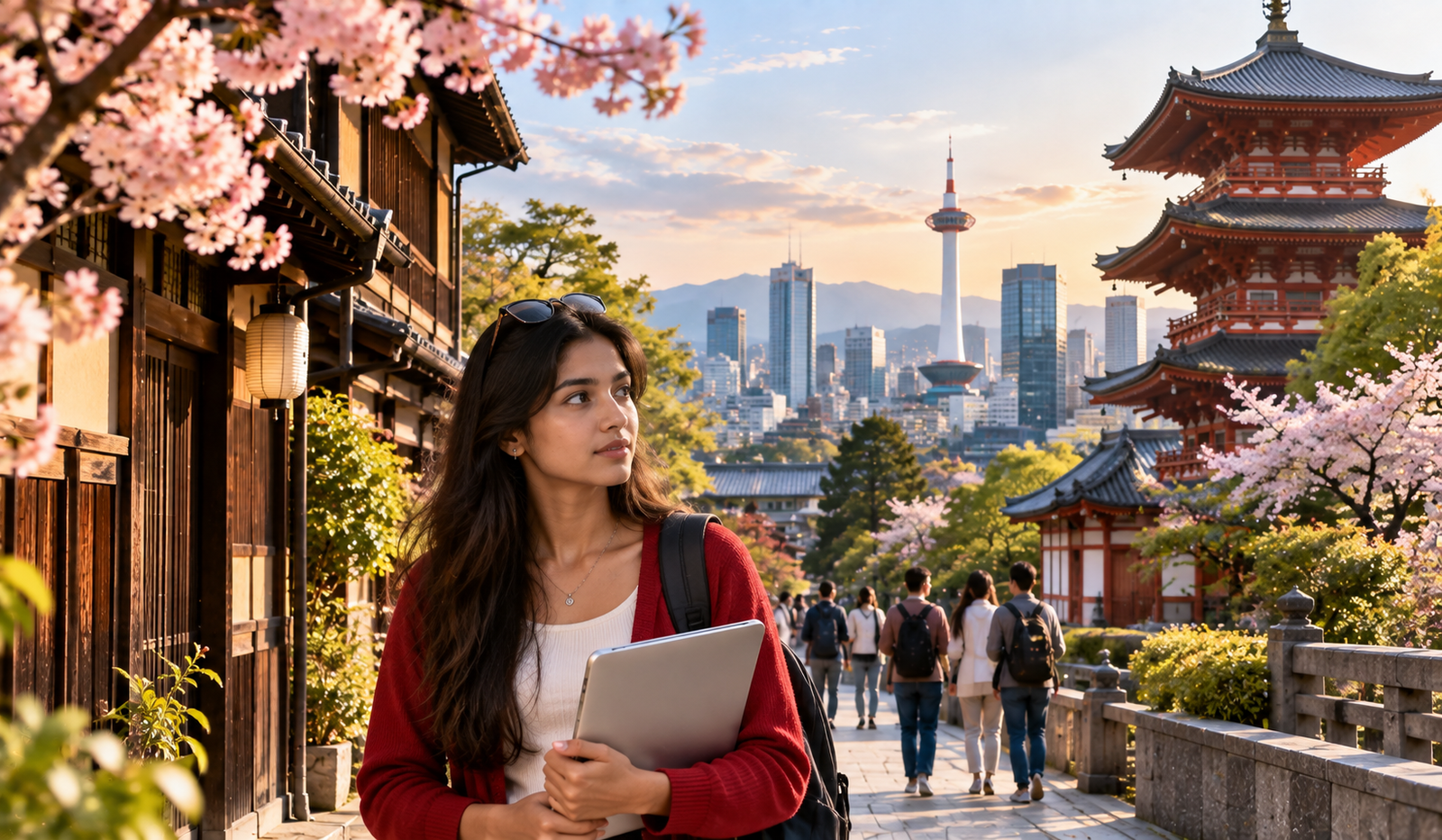
A Global Hub for Innovation & Opportunity
Study in an inspiring blend of ancient tradition and cutting-edge high-tech innovation, offering a unique ecosystem to connect your academic learning with future-forward global industries.
Understand the Japanese Higher Education System
Japan has national, public and private universities, along with specialised higher-education institutions. Study structures, entrance examinations and language requirements can differ significantly, so understanding how the system works is important before choosing a programme.
Types of Higher Education Institutions
Japan's higher-education system includes national, local public and private universities, as well as specialised institutions offering professional and vocational education.
Universities
Japan has 812 undergraduate universities: 85 national, 103 local public and 624 private institutions. Most bachelor's programmes take 4 years, while medicine, dentistry, veterinary medicine and certain pharmaceutical programmes normally take 6 years.
Specialised Training Colleges
These institutions focus on practical and vocational education. Post-secondary programmes can lead to a Diploma after 2–3 years or an Advanced Diploma after 4 years, depending on the programme.
Choose the Right Study Level
Japan generally follows a 4-year undergraduate, 2-year master's and 3-year doctoral structure, although medicine, dentistry, veterinary medicine and some pharmaceutical programmes follow longer pathways.
Bachelor's Degree
Most undergraduate university programmes take 4 years and lead to a Bachelor's degree. Medicine, dentistry, veterinary medicine and certain pharmaceutical programmes normally require 6 years.
Master's Degree
A Master's programme generally takes 2 years after a bachelor's degree and provides advanced study and specialisation in a chosen field.
Doctorate / PhD
Doctoral study is research-focused and generally takes around 3 years after a master's degree. Some Japanese doctoral programmes are structured as a 2-year first phase + 3-year second phase.
Public or Private University?
Japan has national, local public and private universities. Tuition and admission costs vary by institution and programme, with private universities generally costing more than national and local public universities.
National & Public Institutions
For undergraduate study, average first-year admission and tuition costs are approximately ¥820,000 at national universities and ¥910,000 at local public universities. Actual costs vary by institution and programme.
Private Institutions
Private universities generally cost more. Most undergraduate programmes average about ¥1,300,000 for the first year, while medicine, dentistry and pharmacy can cost around ¥3,800,000.
Japanese-Taught or English-Taught?
Japan offers degree programmes in both Japanese and English. Japanese-taught programmes can involve JLPT and EJU requirements, while English-taught programmes may not require Japanese proficiency.
Japanese-Taught Programmes
For Japanese-taught programmes, JLPT N2 or N1 may be required. Many universities also use EJU, with JLPT N2 + 250 Japanese-section points as a common guideline. Requirements vary by university.
English-Taught Programmes
English-taught programmes are available, especially at universities and graduate schools. IELTS, TOEFL or other approved tests may be accepted. Some institutions may also accept MOI, subject to their requirements.
How to Choose the Right Programme in Japan
Before choosing a Japanese institution, identify the programme that matches your academic background, career goals and preferred language of study. Japan also has university-specific entrance examinations and application requirements that need to be checked before applying.
Plan Your Budget Before You Apply
Study costs in Japan vary by institution, programme and location. National and public universities are generally more affordable, while private and specialised programmes can cost more. Living costs also vary by region.
Understand What You Pay for Your Education
National Universities
¥820,000 / first yearAverage first-year cost at a national university is approximately ¥820,000, including admission and tuition. Graduate programmes are also around ¥820,000.
Local Public Universities
¥910,000 / first yearThe average first-year academic cost at local public universities is approximately ¥910,000 for undergraduate programmes. Graduate-school costs average around ¥900,000.
Private Universities
¥1,300,000 / first yearThe average first-year cost at private universities is approximately ¥1,300,000 for undergraduate programmes. Medical, dental and pharmaceutical programmes average around ¥3,800,000.
Japan's official Study in Japan figures show average first-year academic costs by institution type. Students should check the exact admission, tuition and programme fees for their chosen institution before applying.
What You May Spend Each Month
The latest official Study in Japan figures put the national average monthly living cost at ¥105,000, excluding tuition and other study/research expenses. Tokyo is higher, with average rent of ¥57,000 compared with the national average of ¥41,000.
Accommodation
¥41,000–¥57,000 / monthThe national average rent for international students is approximately ¥41,000 per month, rising to around ¥57,000 in Tokyo. Rent varies depending on location and accommodation type.
Food & Groceries
¥32,000 / monthFood accounts for approximately ¥32,000 per month in the national-average international-student expenditure breakdown.
Health & Medical
¥3,000 / monthThe national-average expenditure breakdown allocates approximately ¥3,000 per month to insurance and medical expenses.
Transportation
¥4,000 / monthThe national-average international-student expenditure breakdown shows approximately ¥4,000 per month for commuting expenses.
Utilities
¥8,000 / monthElectricity, gas and water account for approximately ¥8,000/month in the national-average expenditure breakdown.
Personal & Leisure
¥17,000 / monthThe national-average breakdown allocates approximately ¥8,000 to hobbies and entertainment and ¥9,000 to other daily expenses.
Estimated Monthly Living Cost
The official Study in Japan figure for international students is approximately ¥105,000 per month, excluding tuition and study/research expenses. Tokyo and other major metropolitan areas can cost more than the national average.
Scholarships That May Help Reduce Your Costs
MEXT Scholarship
MEXT Scholarship: ¥117,000/month for undergraduate students and ¥144,000–¥145,000/month for Master's and doctoral students, with tuition exemption and travel support.
JASSO Honors Scholarship
The Monbukagakusho Honors Scholarship provides ¥48,000/month for eligible undergraduate and graduate students. Japanese language institutions receive ¥30,000/month.
JASSO Student Exchange Scholarship
For eligible students coming to Japan under qualifying student-exchange agreements, JASSO provides ¥80,000 per month for periods ranging from 8 days to 1 year.
MEXT offers tuition exemption and monthly support, while JASSO provides monthly assistance for eligible students. Check each scholarship's eligibility and application route before applying.
From Application to Arrival
Understand the key requirements, documents, timelines and financial criteria involved in applying to study in Japan and securing your Certificate of Eligibility and student visa.
Admission Process & Requirements
Admission requirements in Japan depend heavily on your chosen institution type, whether language school, vocational college, or university, and your prior academic and language background.
Academic Pathways
For undergraduate programs or vocational studies, standard entry requires completing 12 years of formal school education. For Master's or doctoral programmes, a recognized Bachelor's or Master's degree is required.
- Minimum education: successful completion of high school or equivalent for undergraduate paths.
- Higher education: bachelor transcripts and degree certificates for graduate entries.
Language Proficiency
Depending on whether you study in an English-medium or Japanese-medium programme, specific language standards apply.
Japanese-taught programmes
Generally require JLPT N2 or N1 certification, or basic foundational study for language schools.
English-taught programmes
Accepted via standard tests like IELTS or TOEFL, or through an official Medium of Instruction (MOI) certificate proving prior education in English.
Entrance Examinations
Many Japanese universities and colleges require standardized testing or independent entrance assessments as part of selection.
- EJU (Examination for Japanese University Admission): commonly used for undergraduate international admissions.
- Institution-specific tests: academic interviews, written exams, or essay evaluations administered directly by the university.
Documents You May Need
Application packages require careful compilation of historical records and personal statements:
- Graduation certificates and academic transcripts
- Valid passport copy
- Language test score certificates
- Statement of purpose or study plan
- Photographs meeting standard specifications
Intakes & Application Deadlines
April Intake (Main Intake)
Aligns with the Japanese academic and fiscal year. Application deadlines generally fall between September and November of the preceding year.
October Intake (Alternative Intake)
Commonly offered by universities with international tracks and language schools. Application deadlines typically fall between April and June of the same year.
Institutional Sponsorship
In Japan, your educational institution acts as your primary liaison with immigration authorities. Once you clear institutional admissions and pay initial tuition fees, the school applies for your Certificate of Eligibility on your behalf.
University admission alone does not permit entry; it triggers the official immigration sponsorship sequence.
Your Admission Journey
A practical timeline for planning your application to Japan:
Choose Institution
Select course style, language track, and intake term.
Prepare Tests
Clear language thresholds like JLPT, EJU, or IELTS.
Submit Application
Provide academic records and personal statements.
Pay Initial Fees
Settle application and initial tuition deposits.
COE Processing
School initiates Certificate of Eligibility filing.
Certificate of Eligibility & Student Visa Process
Obtaining a Japanese student visa requires a two-step procedure: securing a Certificate of Eligibility from domestic Japanese immigration authorities, followed by stamping the visa at your regional embassy or consulate.
Certificate of Eligibility (COE)
The COE is issued by the Immigration Services Agency of Japan. It verifies that your proposed course of study and financial arrangements comply with legal residence standards.
Your school files the COE application on your behalf once admissions are finalized. Processing typically requires 1 to 3 months.
You cannot apply for a student visa at a consulate without holding an approved physical or electronic COE.
Financial Proof
You must demonstrate stable financial backing to cover annual tuition fees and living expenses without resorting to unauthorized employment.
Accepted evidence includes bank balance certificates, scholarship award documents, or formal sponsor guarantees.
Estimated First-Year Coverage
Immigration and institutions evaluate applicants against a standard first-year benchmark.
Visa & Application Costs
Official Japanese immigration and consular fees are very cost-effective compared to Western destinations:
- COE Processing Fee: Free (¥0 government fee, though some schools charge a small administrative screening fee).
- Consular Visa Stamping: JPY 3,000 (INR 500–600 depending on embassy exchange rates) for single entry.
- VFS / VAC Service Fee: Approx. INR 650–1,200 depending on the application centre in India.
Nominal Visa Processing Cost
Embassy visa stamp fee (Single Entry).
Visa Application Documents
Once your COE is issued, submit your passport file to your local Japanese embassy or visa center:
- Valid passport with appropriate validity
- Completed visa application form
- Original Certificate of Eligibility and photocopy
- Recent passport-sized photograph
- Letter of acceptance from the Japanese institution
- Financial documentation and sponsor support letters
Post-Arrival Formalities
Upon entering Japan, several mandatory administrative duties must be completed promptly:
- Residence Card (Zairyu Card): issued at major international airports upon arrival.
- Ward Office Registration: register your local address within 14 days of entry.
- National Health Insurance (NHI): mandatory enrollment at municipal office for discounted care.
- Work Permit: apply at the port of entry for permission to work up to 28 hours per week.
Visa & COE Journey
Secure Admission
Confirm acceptance and pay initial tuition fees.
File COE Package
School submits immigration documents on your behalf.
Receive COE
Obtain physical certificate issued by Japanese authorities.
Embassy Stamping
Submit passport and COE to local consulate for visa issuance.
Arrival & Setup
Land in Japan, collect residence card, and register at ward office.
Plan Your Next Steps After Graduation
Studying in Japan can provide opportunities to gain work experience during your studies and continue into employment after graduation.
Working While Studying
International students in Japan can work part-time alongside their studies after obtaining the required permission from the immigration authorities.
Eligible international students can work up to 28 hours per week while studying and up to 8 hours per day during long school holidays.
After Graduation
Graduates who have not yet secured employment may be able to remain in Japan under the Designated Activities status to continue their job search.
Eligible graduates can continue job-search activities for up to one year after graduation, subject to required conditions and institutional recommendation.
Long-Term Residence
International graduates who build a qualifying career in Japan may later pursue longer-term residence through applicable immigration routes.
Highly skilled professionals may qualify for a shorter residence period under Japan's points-based system, including routes based on 70 or 80 points.
IMPORTANT CONDITIONS
Work and post-study residence options in Japan depend on your residence status, permission to work, employment situation, qualification and individual circumstances. Job-search and permanent-residence routes have their own eligibility requirements. Always check the latest requirements with the relevant Japanese authorities before making plans.
Leading Universities in Japan
Explore selected Japan universities across research-focused and career-focused education. Click any university to visit its official website.
Research-Focused Universities
Career-Focused & Professional Universities
Find Your Student Accommodation in Japan
Choose from different accommodation options based on your budget, lifestyle, and university location.
Student Residences
University or privately operated student dormitories offering furnished rooms, shared facilities, and communal spaces. Dormitories can be more affordable than private apartments but often have limited availability.
Shared Apartment
Rent a private room in an apartment shared with other students or tenants while sharing the kitchen and living spaces.
Private Apartment
A studio or independent apartment offering greater privacy and flexibility. Initial costs may include a deposit, key money, agency fees, and furniture or appliances.
Things to Consider
- Location and commute to your university
- Monthly rent and included facilities
- Furnished or unfurnished accommodation
- Access to public transport and essential services
When Should You Start Looking?
Begin researching accommodation as soon as your university acceptance is confirmed. Student dormitories have limited availability, while private apartments may require additional time for rental procedures, guarantor arrangements, and initial costs.
Find Accommodation Before You Travel
GEMS helps students explore suitable accommodation options and understand their housing choices before travelling to Japan.
Options
Your First Steps After Arriving in Japan
From legal municipal registration to local transport passes, complete these mandatory Japanese administrative procedures to settle smoothly into your student life.
Register at Your Ward or City Office
Visit your local municipal office (Shiyakusho or Kuyakusho) within 14 days of moving into your permanent housing. You must complete Resident Registration (Jūminhyō) to have your official address printed on the back of your Residence Card (Zairyū Card).
Carry Your Residence Card & Part-Time Work Permit
You are legally required to carry your Residence Card (Zairyū Card) at all times in Japan. If you plan to work part-time (up to 28 hours per week), confirm that you received your Shikakugai Katsudō Kyoka permission stamp from airport immigration upon arrival.
Open a Japan Post Bank Account
Standard Japanese commercial banks generally do not permit international students to open full accounts during their first six months. Open an account with Japan Post Bank (Yūcho Ginko) first—it is universally accepted for tuition debits, utility bills, and scholarship disbursements.
Enrol in National Health Insurance & Pension
Sign up for National Health Insurance (Kokumin Kenkō Hoken) at your ward office during registration to cover 70% of medical and dental expenses. Students can also apply for the income-based insurance discount and the National Pension (Kokumin Nenkin) student exemption.
Set Up a Japanese SIM & Student Commuter Pass
Obtain a Japanese voice-enabled phone number (starting with 070, 080, or 090), which is mandatory for bank accounts and official paperwork. Take your student ID to a train station office to purchase a discounted Student Commuter Pass (Tsūgaku Teikiken) on a Suica, Pasmo, or ICOCA card.
Secure Your My Number & Personal Seal (Hanko)
Safely store the Individual Number (My Number) notification paper mailed to your address. You may also need to purchase a personal name seal (Hanko or Inkan), which is frequently required alongside a signature for housing contracts, university enrollment, and official documents.
READY TO TAKE
The Next Step
Tell us a little about your study plans, and let's explore the right destination and opportunities for your future.
Personalised Guidance
Tailored support based on your goals and study plans.
Global Opportunities
Explore the best universities and courses worldwide.
End-to-End Support
Support at every step of your study abroad journey.
READY TO TAKE THE NEXT STEP
Book Your Free Consultation
Share your study plans and get personalised guidance from our team.
Thank You!
Your consultation request has been received successfully.
Our team will review your details and get in touch with you soon.
Everything You Need to Know About Studying in Japan
Tuition fees vary by university and programme. As a broad guide, first-year fees at national universities are around ¥820,000, while private universities may cost approximately ¥1.1 million–¥1.3 million or more, excluding specialised medical programmes. Living expenses generally range from around ¥80,000 to ¥150,000 per month, depending on the city and lifestyle. Tokyo and other major cities can be more expensive.
Yes. Japan has a growing number of English-taught programmes, particularly at the postgraduate level and in fields such as engineering, technology, business, science and international studies. However, Japanese-language programmes require Japanese proficiency, and learning basic Japanese can be extremely helpful for daily life, part-time work and future employment. English-taught programmes commonly require IELTS, TOEFL or another recognised English-language test. Some universities may also accept a Medium of Instruction (MOI) certificate, depending on their individual admission policy.
For undergraduate programmes, students generally need a recognised Class 12 qualification, while postgraduate applicants need a recognised Bachelor’s degree. Universities may require academic transcripts, proof of English or Japanese proficiency, a statement of purpose, letters of recommendation, CV, passport and, for some programmes, entrance examinations or interviews. English-taught programmes commonly ask for IELTS, TOEFL or similar recognised tests, while Japanese-taught programmes may require Japanese-language qualifications such as JLPT or other accepted proof of proficiency. Some universities may also accept an MOI certificate for English-taught programmes, subject to their own rules.
Japan does not have one universal fixed bank-balance amount for every student. Applicants generally need to demonstrate that they or their financial sponsor can cover tuition and living expenses throughout the period of study. As a practical planning guide, students should budget approximately ¥1.5 million–¥2.5 million or more for the first year, depending on tuition, accommodation and location. Financial documents may include bank statements, income certificates and evidence showing the source of funds.
Yes. International students with permission to engage in activities outside their student status can generally work part-time for up to 28 hours per week during academic periods and up to 8 hours per day during long university holidays, subject to applicable conditions. Japanese-language ability can make it easier to find suitable part-time work. Students should not rely on part-time income as their main source of financial support.
Yes. Graduates who secure suitable employment may apply to change from Student status to an appropriate work-related status of residence. Eligible graduates who have not yet found a job may generally continue job hunting in Japan by changing to a Designated Activities status, initially for six months with, in principle, one renewal possible. Career opportunities are particularly relevant for graduates with Japanese-language ability and qualifications aligned with Japan's employment requirements.
Scholarships are available through universities, the Japan Student Services Organization (JASSO), the Japanese Government’s MEXT scholarship programme and private foundations. Funding may include tuition reductions, monthly stipends, admission-fee waivers or research support. Competition and eligibility vary, so students should check scholarship deadlines alongside their university applications.
Ideally, begin preparing 12 to 18 months before your intended intake. This allows time for university research, language testing, entrance examinations where applicable, document preparation, financial planning, scholarship applications, the Certificate of Eligibility process and student visa preparation. Japanese-language preparation should begin early if you are considering a Japanese-taught programme.
Yes. Japanese national and local public universities charge tuition and admission fees to international students. National universities generally have more standardised and comparatively moderate fees, while local public and private universities may charge different amounts. Scholarships, tuition reductions and university-specific exemptions can help lower the total cost.
Yes. GEMS can guide you through university and programme selection, English- or Japanese-language requirements, application documentation, scholarship planning, financial preparation and student visa procedures. Our team can help you organise the application process from initial shortlisting through admission and pre-departure preparation.